
Scoring AI value, feasibility and risk
Most enterprises have a list of AI ideas. Far fewer have a portfolio: a scored, sequenced set of investments with owners and decision gates. The difference determines whether AI spending compounds or fragments.
We engage with you, understand your needs, and map out where AI fits in your operation to deliver solid business results.
Top 3 problems
Different companies, different budgets, the same three problems every time.
Disconnected Approach
Ad-hoc approach to AI Implementations without understanding the bigger picture
AI as a Bolt-on Approach
AI is a “bolt-on” on top of unchanged processes. Employees still do a lot of manual work.
Inadequate Data and Technical Infrastructure.
Information is incomplete, disconnected, duplicated, outdated, poorly classified and trapped in separate systems.
Want to avoid AI pilots that go nowhere?
Check our AI readiness scorecard. 28 questions to tell a solid AI opportunity from an expensive experiment.
Services
Five service lines, one complete AI-first offer, organized around enterprise problems and concrete outcomes.
AI Ambition & Strategy
Focus investment on the use cases that matter, and create the operational model to scale them.
Explore the service →
Operating Model
Fundamentally redesign and integrate intelligence in workflows, with human oversight and control.
Explore the service →
Data & AI Foundations
Create a Data Environment That’s Ready for AI Adoption.
Explore the service →
New products & Services
Scale insights, content and personalization to drive growth, while maintaining authenticity.
Explore the service →
Responsible AI, Governance & Compliance
Turn policies into practical controls across operation to protect brand and customer trust.
Explore the service →
Case Studies
Get an understanding of how robust production agents are designed, deployed, and drive business results.
Most enterprises have a list of AI ideas. Far fewer have a portfolio: a scored, sequenced set of investments with owners and decision gates. The difference determines whether AI spending compounds or fragments.
Pilots prove that something works in principle. Production requires an operating model. Six gaps explain most of the distance between a promising demo and a capability the business actually runs on.

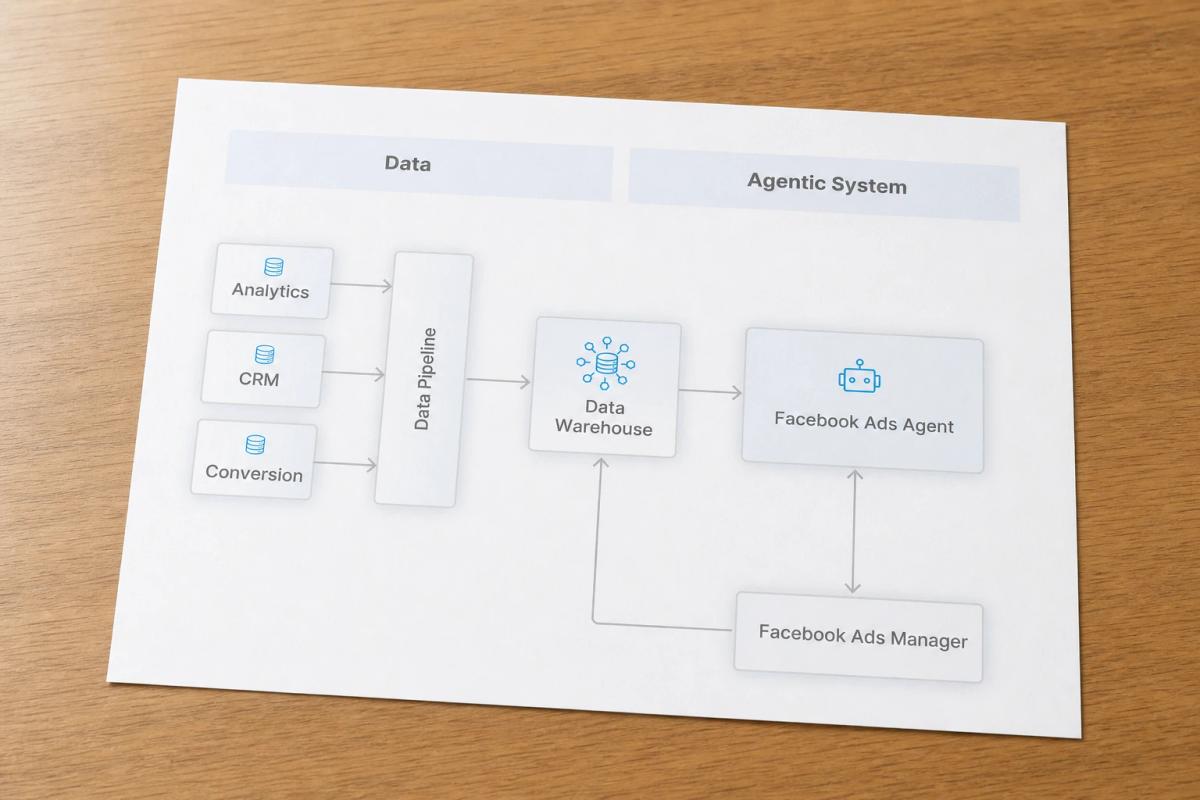
This case study walks through the full lifecycle of a Facebook Ads Agent, from first idea to a fully operational agentic system running in production. The agent is made up of a small team of specialists, a defined set of inputs, a strict list of things it's allowed to touch inside Meta, and a governance layer that keeps its behaviour in check. But the thing that matters most is the data feeding the agent and what business context we give it. If we fail to define a proper business scope for the agent, it will optimise a metric that could hurt the business. For example, if we ask the agent to drive revenue, it might push a product that has a 40% return rate. So if it doesn't have the right scope, it will develop tunnel vision.
How we work
Phase 0
Agree outcomes, scope, ways of working and access.
Phase 1
Understand work, users, data, platforms, controls and constraints. Establish the foundation.
Phase 2
Design the architecture and operation boundaries.
Phase 3
Engineer the production capability and connect it to real systems and controls.
Phase 4
Embed the capability in roles, decisions and daily work.
Phase 5
Sustain quality, manage risk and compound value.
Why us
Most organizations already hold the pieces: an ambition, a data platform, teams who want to use it and obligations nobody has mapped to the work. What is usually missing is the line between them. We work from the boardroom to the build room so those pieces add up to something that runs.
Notes on moving AI initiatives from pilot to production: what stalls them, what the evidence actually supports, and what we would do differently.